What Are Learning Styles – And Why They Matter for Your Child
Introduction
Every child learns in their own way:
- Some need to see things.
- Others need to hear them.
- Some need to move, touch, or experiment.
- And some children appear flexible — able to switch between styles depending on the situation.
Learning styles are partly innate and partly learned. Most children are born with a natural preference toward one of the three core styles – visual, auditory, or kinesthetic. Over time, through experience, environment and habits, they may develop the ability to learn in multiple ways. That’s where flexible learners come in: flexibility is often built, not born.
When parents understand these natural tendencies and how they evolve learning becomes easier, calmer and far more effective.
Learning styles aren’t labels. They’re tools: a way to understand how your child’s brain naturally absorbs information. And when you work with that, instead of against it, everything changes.
The Four Learning Styles We Use at Tech & Trees
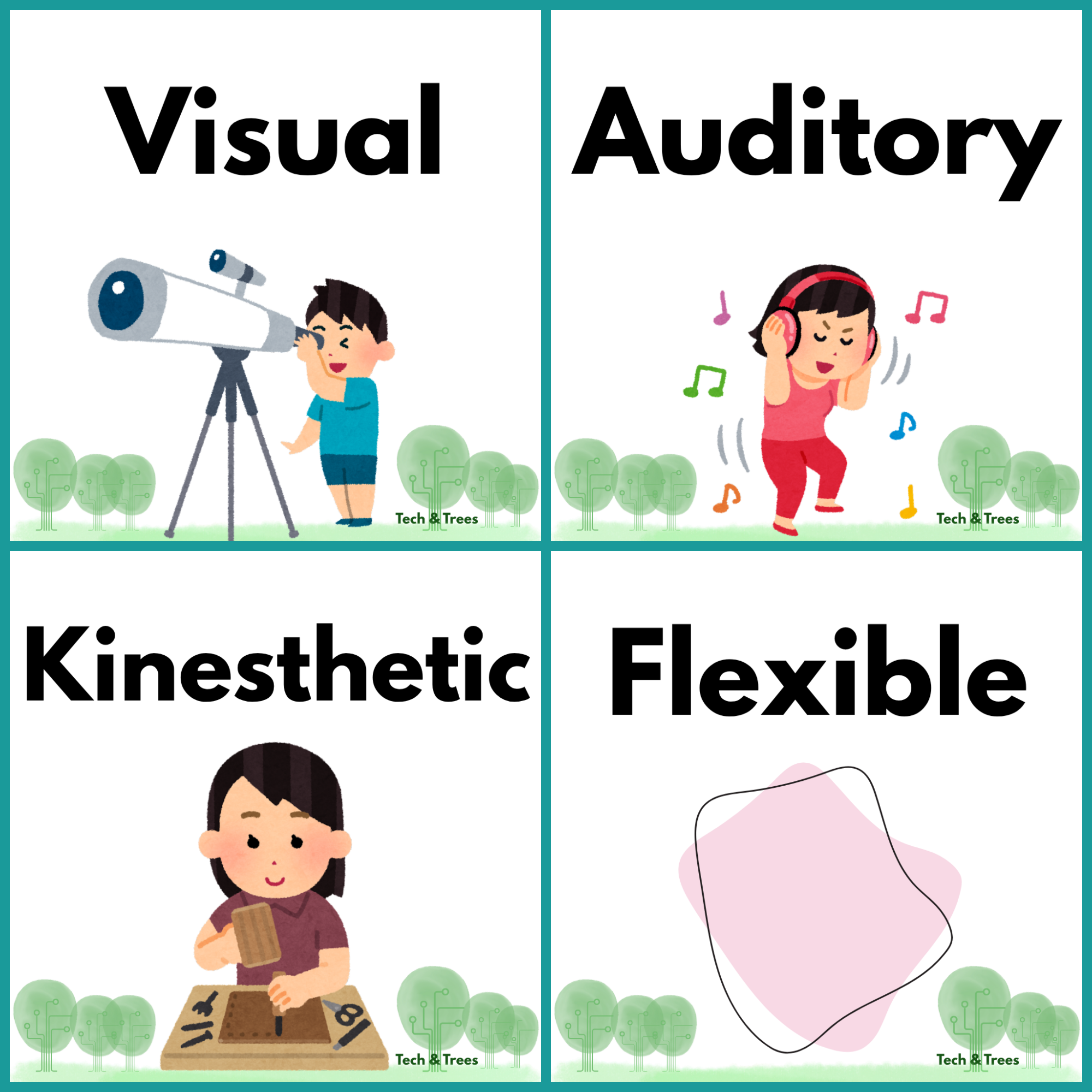
At Tech & Trees, we focus on four practical, research‑aligned learning styles that help parents understand how their child learns best:
- Visual Learners
- Learn best through images, diagrams, colors, charts, and visual structure.
- Auditory Learners
- Learn best through listening, speaking, rhythm, and verbal explanation.
- Kinesthetic Learners
- Learn best through movement, hands‑on activities, physical experience, and doing.
- Flexible Learners
- Learn well in multiple ways and switch styles depending on the task, environment, or mood. They don’t have one dominant preference — and that’s a strength.
These styles aren’t fixed personality traits. They’re flexible tendencies that help you understand what makes learning feel natural for your child.
Why Learning Styles Matter
1. They reduce frustration — for both parent and child
When a child struggles, it’s often not because the topic is too hard. It’s because the method doesn’t match their brain.
2. They make learning faster and more enjoyable
A visual learner who gets a diagram instead of a long explanation? A kinesthetic learner who can move while practicing spelling? A flexible learner who thrives when they can choose their approach? That’s when learning clicks.
3. They help parents support their child with confidence
Instead of guessing, you know what works — and why.
4. They build long‑term learning habits
Children who understand how they learn become more independent, motivated and self‑aware.
Examples From Real Life
Here are a few everyday moments where learning styles make a difference:
- Your child remembers every detail from a picture book but forgets verbal instructions → visual learner
- Your child repeats new information out loud or talks through problems → auditory learner
- Your child can’t sit still during homework but learns instantly when doing something hands‑on → kinesthetic learner
- Your child adapts easily to different tasks and methods → flexible learner
These aren’t problems. They’re clues.
How to Use Learning Styles at Home
You don’t need a complicated system. Start simple:
- Offer information in more than one format
- Let your child choose how they want to practice
- Use visuals, movement, sound or structure depending on what works
- Notice what feels effortless for them — that’s the key
Small adjustments often create the biggest breakthroughs.
Start With Yourself First
Before you can understand your child’s learning style, it helps to understand your own. Your natural style influences how you explain things, how you teach, and what you expect.
That’s why the first step in Tech & Trees is always: Know your own learning style.
👉 Start here: Take the free Learning Styles Test for Parents
It’s the simplest way to understand your own learning preferences and the first step to supporting your child with clarity and confidence.